Table tennis robots make solo practice more structured by delivering repeatable serves, adjustable spin, and programmable ball patterns without requiring a training partner. The right machine can help beginners build consistency while giving experienced players more control over focused drills.
This roundup compares 10 table tennis robots for home practice, covering portable models, app and remote controls, built-in nets, large drill libraries, and machines designed for straightforward repetition.
Best 10 Table Tennis Robots for Home Practice Picks for 2026
Most Customizable

- 522 preset drills plus custom programming
- App and remote control with detailed adjustments
- Portable 8.8-pound design with one-year warranty
Best For: Highly customizable solo practice and coaching
Best for Portability
PONGBOT Robot with Carrying Bag

- Includes a carrying bag with utility pocket
- Comes with remote and power adapter
- Compact 18.31-inch package length
Best For: Convenient storage and transport
Best Simple Setup

- No app required for operation
- Wireless remote controls key settings
- Serves up to 70 balls per minute
Best For: Beginners and uncomplicated solo practice
Best for Full-Court Coverage
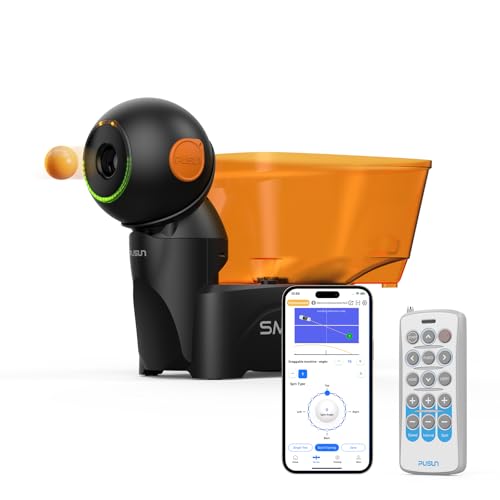
- Triple-motor launching system
- 200-plus preset drills and custom settings
- Designed for full-table placement coverage
Best For: Placement-focused receiving practice
Best for Adjustable Spin
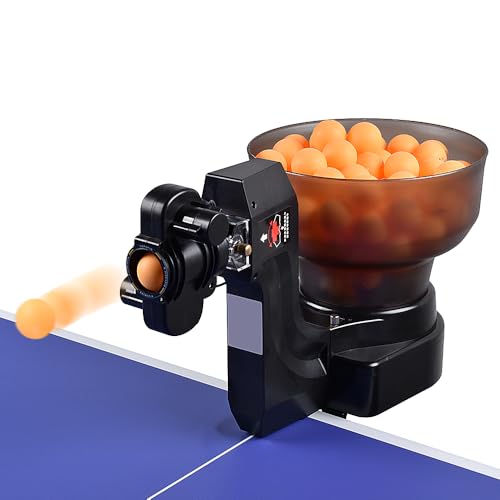
- Nine spin modes with dual-motor serving
- 8.9–76 mph speed and adjustable pitch
- 120-ball hopper with two-year warranty
Best For: Home players seeking varied spin and portable setup
Best for App-Based Drills

- 264 pre-saved drills included
- Remote and smartphone-app control
- Ball-recycling net included
Best For: Players wanting guided and customizable solo workouts
Best for Continuous Practice

- Integrated net feeds balls into a 200-ball hopper
- Nine spin modes and 8.9–76 mph speed
- Includes 100 balls and two-year warranty
Best For: Players wanting extended drills with minimal ball pickup
Best Programmable Pick

- 396 pre-saved trajectories across 66 drills
- App and remote control options
- Includes ball-recycling net
Best For: Structured solo training with customizable routines
Best Simple-Control Option
Adjustable Spin Ping Pong Robot

- 35–90 balls per minute
- Nine spin modes and shortcut keys
- Recycling net included
Best For: Directly controlled practice across varied serve types
Best Warranty Coverage

- Recycling net holds up to 200 balls
- 8.9–76 mph speed range and nine spin modes
- Includes 100 balls and ambidextrous control
Best For: High-volume solo practice with flexible setup
Most Customizable – NOVA S Pro Smart Robot
For players comparing table tennis robots for home practice, the NOVA S Pro stands out for its extensive drill library and detailed adjustments. App and remote controls let you tune speed, spin, frequency, height, and landing point, while the portable 8.8-pound design suits solo sessions.
Best For: Players and coaches who want highly programmable practice sessions, from beginner drills to advanced placement and spin work.
Pros:
- Offers 522 preset drills plus custom drill programming.
- Provides 21 speed levels, 21 rotation levels, nine spin types, and adjustable frequency.
- Supports app or remote control, with landing-spot animation in the app.
- Includes a one-year warranty and near-net serve trajectory for short-range practice.
Cons:
- 40mm-plus balls and two AAA batteries are not included.
- The extensive controls may take time to learn.
This is a strong choice when variety and precise customization matter more than simple plug-and-play operation.
Best for Portability – PONGBOT Robot with Carrying Bag
If convenient storage and transport are priorities in table tennis robots for home practice, this PONGBOT package adds a carrying bag to the robot and standard accessories. Its soft-shell bag includes an adjustable strap and utility pocket for moving the equipment between home, clubs, or coaching sessions.
Best For: Players who want a robot package that is easier to carry and store after practice.
Pros:
- Includes a carrying bag with adjustable strap and utility pocket.
- Comes with the robot, N-Control S remote, and power adapter.
- Compact listed dimensions of 18.31 by 13.38 by 6.93 inches.
- Includes a one-year manufacturer warranty.
Cons:
- The supplied notes do not specify drill count, speed range, spin options, or ball capacity.
- At 5 kg, it is not especially lightweight for a portable training device.
Choose this version when the included bag is more useful to you than a detailed feature set; confirm the robot’s training controls before buying if customization is important.
Best Simple Setup – JOOLA iPong V300
The JOOLA iPong V300 is a straightforward option among table tennis robots for home practice. It requires no app, assembles by attaching the ball feeder to the shooter, and uses a wireless remote to adjust frequency, speed, direction, and spin from the opposite side of the table.
Best For: Beginners, families, and players who want accessible solo practice with basic control over ball delivery.
Pros:
- Simple setup without app downloads or complicated instructions.
- Wireless remote includes memory buttons for on-the-fly changes.
- Adjusts ball frequency from 30 to 70 balls per minute.
- Controls direction, speed, topspin, and backspin.
Cons:
- The notes do not mention programmable drills or app-based customization.
- It has fewer documented settings than the more advanced robots in this roundup.
With its quick assembly and uncomplicated remote, the V300 is a practical starting point for regular home sessions rather than highly structured advanced training.
Best for Full-Court Coverage – DORA Smart Pro
The DORA Smart Pro targets players seeking broad placement practice from table tennis robots for home practice. Its triple-motor launching system is designed for stable serving, while preset drills, random serves, variable spin, speed, frequency, and customizable combinations support varied receiving work.
Best For: Players who want wide table coverage and a mix of preset and personalized drills.
Pros:
- Uses a triple-motor launching system for precise, stable serving.
- Includes more than 200 preset training drills with one-click starts.
- Supports full-court placement, random serves, variable speed, frequency, and spin.
- Includes a remote and a stated 1.5-year warranty in the product details.
Cons:
- The listed dimensions are unusually large, so available space should be checked carefully.
- The supplied information contains different warranty references: three years in the feature notes and 1.5 years in the details.
- The notes do not specify ball capacity.
This model is appealing for placement-focused practice, but verify the physical dimensions and warranty term with the seller before ordering.
Best for Adjustable Spin – Portable HP-07
For shoppers comparing table tennis robots for home practice, the WAYMARK HP-07 is a portable option focused on adjustable spin and speed. Its dual-motor design offers nine spin modes, automatic oscillation, and a 120-ball hopper, while the clamp-on mount fits tables up to 2.5 inches thick.
Best For: Players who want varied spin drills and adjustable serving intensity in a compact home-training setup.
Pros:
- Nine spin modes, including topspin, backspin, sidespin, and non-spin.
- Adjustable serving speeds from 8.9 to 76 mph and customizable pitch angles.
- 120-ball hopper and tool-free mounting for tables up to 2.5 inches thick.
- Includes a two-year warranty with replacement-part and machine-replacement support.
Cons:
- The ball-catch net is sold separately.
- The included package contains 50 balls, fewer than the hopper’s maximum capacity.
The HP-07 is a practical choice for solo players who value spin variety and simple setup. Its separately sold net may add to the overall cost if you want a more contained practice area.
Best for App-Based Drills – PONGBOT NOVA S Pro
The PONGBOT NOVA S Pro stands out among table tennis robots for home practice because it combines a recycling net with remote and smartphone-app control. Its 264 pre-saved drills and custom-drill capability give players a structured way to vary sessions across skill levels.
Best For: Players who prefer guided training programs, app control, and the convenience of an included ball-recycling net.
Pros:
- Includes a ball-recycling net to simplify setup and practice.
- Offers 264 pre-saved drills for a broad range of training options.
- Supports both remote control and smartphone-app operation.
- Allows users to create custom drills.
Cons:
- The warranty is one year, shorter than the two-year coverage listed for the WAYMARK models.
- The supplied notes do not specify spin modes, serving-speed range, or hopper capacity.
Choose the NOVA S Pro if drill variety and flexible controls matter more to you than detailed mechanical adjustments. The included net and custom-drill support make it especially appealing for organized solo sessions.
Best for Continuous Practice – WAYMARK S6-PRO
For uninterrupted table tennis robots for home practice sessions, the WAYMARK S6-PRO pairs an integrated recycling net with a 200-ball hopper. It includes 100 balls, nine spin options, adjustable speed from 8.9 to 76 mph, and a mounting design that fits standard tables up to 2.5 inches thick.
Best For: Players who want extended solo drills without repeatedly stopping to collect balls.
Pros:
- Integrated net recycles balls directly into the 200-ball hopper.
- Nine spin options and an 8.9–76 mph speed range support varied training.
- Control panel can mount on either the left or right side of the table.
- Includes 100 balls and a two-year warranty.
Cons:
- At 7.5 kg, it is heavier than the HP-07 listed here.
- It requires a table no more than 2.5 inches thick for mounting.
The S6-PRO is the strongest fit for players who prioritize ball recycling and longer practice blocks. Its larger, heavier design is worthwhile when minimizing ball pickup is more important than maximum portability.
Best Programmable Pick – OMNI S Pro
For players comparing table tennis robots for home practice, the OMNI S Pro stands out for its extensive drill library and dual-control setup. It offers 396 pre-saved ball trajectories, plus app-based customization for more structured solo sessions.
Best For: Players who want programmable drills, visual training routines, and app or remote control.
Pros:
- Includes 396 pre-saved trajectories across 66 drills, with forehand and backhand options.
- Adjusts ball speed, spin, frequency, trajectory, and landing point for customized practice.
- Includes both the E Pad S remote and Pongbot app, along with a ball-recycling net.
Cons:
- 40mm or 40mm+ balls are not included.
- At 19.8 pounds, it is relatively substantial to move and store.
The OMNI S Pro is a strong choice for home users who prefer a broad selection of ready-made exercises but still want to build their own routines. Its app library and dual-control options add flexibility for ongoing training.
Best Simple-Control Option – Adjustable Spin Ping Pong Robot
This table tennis robot for home practice offers straightforward wired-remote control and a useful range of serving adjustments. With nine spin modes, variable speed and frequency, and fixed-point or random serving, it can support varied solo sessions.
Best For: Beginners and recreational players who want adjustable serves with convenient shortcut controls.
Pros:
- Serves 35–90 balls per minute and offers a listed speed range of 4–40 m/s.
- Provides nine spin modes, including topspin, backspin, no-spin, and chopping-ball settings.
- Includes a recycling net to collect most balls during solo practice.
Cons:
- Uses a wired remote rather than app control.
- The supplied notes do not specify how many balls are included.
Its shortcut keys make common drills quick to select, while the adjustable landing point, speed, frequency, and spin intensity allow practice to progress beyond basic repetition. It is a practical option for users who value direct physical controls.
Best Warranty Coverage – WAYMARK Pro JT-A
For table tennis robots for home practice, the WAYMARK Pro JT-A combines automatic ball recycling with broad speed and spin adjustments. Its net holds up to 200 balls, and the detachable control panel can be positioned on either side of the table.
Best For: Players seeking high-volume solo practice, ambidextrous controls, and included training balls.
Pros:
- Automatic recycling net holds up to 200 balls to reduce pickup time.
- Offers 8.9–76 mph serving speeds and nine customizable spin modes.
- Includes 100 balls, and the control panel can be placed on the left or right side.
Cons:
- Fits tables up to 2.5 inches thick, so compatibility should be checked first.
- The supplied notes contain differing warranty references, listing both two years and one year.
The JT-A is designed for efficient, repeatable training, especially when collecting balls would otherwise interrupt a session. Its wide speed range and ambidextrous panel make it adaptable for different players and practice levels.
How We Picked the Best Table Tennis Robots for Home Practice
We focused on the features that matter most during solo training: ball capacity, drill variety, spin and speed adjustment, trajectory control, portability, control methods, and included accessories. Models with nets can simplify setup by collecting balls, while app or remote control can make it easier to change routines without interrupting practice.
We also considered whether each robot suits casual home use, structured skill development, or more advanced repetition. A large number of preset drills is useful, but practical controls and reliable ball delivery are just as important.
Quick Comparison
| Feature | What to Look For | Why It Matters |
|---|---|---|
| Ball capacity | About 100 to 200 balls or more | Supports longer sessions with fewer reloads |
| Drill library | Preset and programmable patterns | Helps vary placement, pace, and repetition |
| Control | Remote, app, or E-pad | Makes adjustments easier during practice |
| Ball collection | Included net or collection system | Reduces interruptions between drills |
| Portability | Compact design, carrying case, or bag | Useful for storage and occasional transport |
Key Buying Factors for Table Tennis Robots for Home Practice
Spin, Speed, and Placement Adjustments
Look for independent control over speed, frequency, spin, and placement. Beginners may prefer gentle, repeatable feeds, while intermediate and advanced players benefit from changing topspin, backspin, sidespin, depth, and lateral position.
Preset Versus Custom Drills
Preset routines are convenient when you want to start practicing quickly. Custom drills are more valuable if you are working on a specific weakness, such as alternating forehand and backhand placement or handling different spins.
Setup, Noise, and Space
Measure your available practice area before buying. A robot with a net may need additional clearance, and larger machines can be less convenient to store. Check how easily the unit attaches to the table and whether ball recovery is practical in your room.
Capacity and Included Accessories
A larger hopper is helpful for longer sessions, but accessories can affect overall value. Nets, remote controls, carrying bags, power adapters, and ball-return features may reduce the need for separate purchases.
Who Should Buy Which Table Tennis Robots for Home Practice?
Beginners: Choose a straightforward robot with simple controls, adjustable speed, and reliable preset drills. Ease of setup matters more than having the largest feature list.
Intermediate players: Prioritize multiple spin settings, placement control, and a broad drill library. App or remote operation can make progressive training more convenient.
Advanced players and coaches: Look for programmable routines, triple-motor or multi-axis control, high repetition capacity, and precise trajectory adjustment.
Small-space users: Favor portable models with a carrying bag, compact storage, or an integrated collection net. Before ordering, confirm table compatibility, power requirements, included balls, and return coverage.