The right weighted vest can make bodyweight exercises, walks, runs, and strength sessions more challenging without requiring a larger home-gym setup. The best choice depends on how much load you need, how securely the vest fits, and whether you prioritize comfort, mobility, or heavy-duty construction.
We compared 10 adjustable and fixed-load options across a wide range of capacities and training styles to help you find a vest that feels stable, practical, and appropriate for your routine.
Best 10 Weighted Vests Picks for 2026
Best for Progressive Training

- Adjustable from 2.5 to 40 pounds
- Padded shoulders and adjustable waist belt
- Reflective stripes support low-light visibility
Best For: Progressive strength, cardio, and full-body workouts
Best for Beginner-Friendly Progression

- Eight weight options from 6 to 30 pounds
- Neoprene design helps reduce chafing
- Shoulder pads and buckle support a snug fit
Best For: Gradual progression in walking and general fitness
Best for Heavy-Duty Rucking

- Adjusts from 0 to 35 pounds
- Includes 16 removable iron weights
- Reinforced construction for demanding workouts
Best For: Rucking, calisthenics, and heavy strength training
Best for Comfortable Adjustable Fit
Sportneer Adjustable Weighted Vest

- Adjustable from 2 to 18 pounds
- Zipper design with shoulder and waist locks
- Removable packs and reflective strips
Best For: Walking, jogging, gym, and moderate strength workouts
Best Everyday Value

- Evenly distributed iron-sand resistance
- Reflective strips and storage pockets
- Available from 6 to 30 pounds
Best For: General fitness, walking, and beginner training
Best Adjustable Heavy-Duty Pick
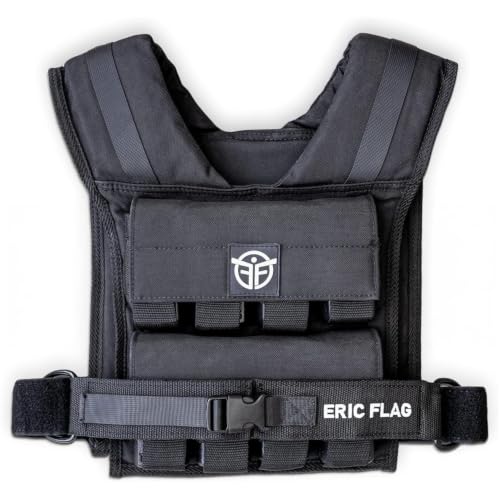
- Adjustable from empty to 40 pounds
- Includes 16 removable iron weights
- Durable 1000D Oxford nylon shell
Best For: Progressive calisthenics and strength training
Best Reflective Training Option
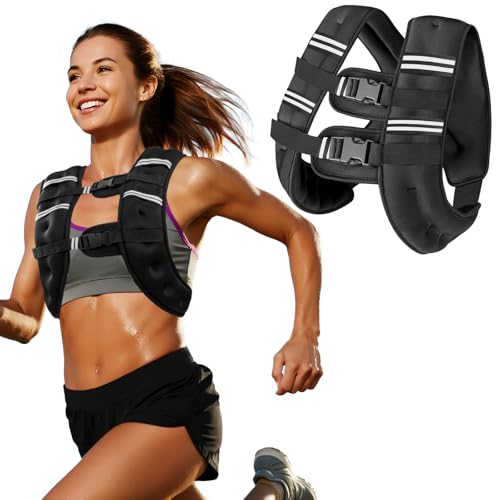
- Front and rear reflective strips
- Evenly distributed iron-sand filling
- Two adjustable elastic straps
Best For: Outdoor walking, running, rucking, and gym workouts
Best Heavy-Duty Pick
APEXUP Adjustable Weighted Vest

- Removable 2.5-pound cast-iron blocks
- 1000D nylon with reinforced stitching
- Padded fit and reflective strips
Best For: Progressive strength training, rucking, and running
Best Comfort-Focused Option
NATURELUX Neoprene Weighted Vest

- Evenly distributed iron-sand filling
- Adjustable clips and elastic straps
- Warranty and money-back guarantee
Best For: Long walks, running, HIIT, and general fitness
Best Versatile Training Pick

- Options from 6 to 30 pounds
- Even iron-sand weight distribution
- Reflective strip and adjustable fit
Best For: Mixed cardio, walking, hiking, and bodyweight workouts
Best for Progressive Training – CAP Adjustable Weighted Vest
For shoppers comparing weighted vests, the CAP Adjustable Weighted Vest stands out as a high-capacity option with removable 2.5-pound weight packets. Its adjustable resistance, padded shoulders, waist belt, and reflective stripes make it suitable for progressively harder strength and cardio sessions.
Best For: Adults who want adjustable resistance for running, walking, push-ups, squats, lunges, and full-body conditioning.
Pros:
- Adjustable resistance from 2.5 to 40 pounds using individual weight packets.
- Padded shoulders and an adjustable waist belt help create a more stable fit.
- Reinforced nylon and polyester construction with reflective stripes for low-light visibility.
- Works for both cardio activities and total-body strength training.
Cons:
- The listed 40-pound configuration may be heavier and bulkier than lighter training vests.
- Hook-and-loop closure may require manual adjustment before each workout.
- The manufacturer warranty is listed as 30 days.
Choose this CAP vest if you want one weighted vest that can progress from lighter resistance to a full 40-pound setup. It is particularly practical for users prioritizing adjustability and versatile training applications.
Best for Beginner-Friendly Progression – Zeerun Weighted Vest
The Zeerun Weighted Vest is a straightforward choice among weighted vests for users who want to increase resistance gradually. It is available in eight weight options, with neoprene construction, thickened shoulder pads, and an adjustable buckle intended to support a snug fit.
Best For: Beginners and progressing users who want to move from lighter walking or workout resistance to heavier options over time.
Pros:
- Available in 6, 8, 10, 12, 15, 18, 24, and 30-pound options.
- Neoprene material is described as skin-friendly and designed to help prevent chafing.
- Thickened shoulder pads and an elastic band help distribute pressure and limit movement.
- Double-stitched seams are intended to withstand rigorous movements.
Cons:
- The listed weights are separate options rather than a removable-weight configuration.
- The maximum listed option is 30 pounds, which may not suit heavier-load training.
- Specific details about reflective visibility are not provided.
This Zeerun model makes sense for shoppers who prefer selecting a vest weight that matches their current level and upgrading later. Its fit-focused design is especially relevant for walking and general fitness routines.
Best for Heavy-Duty Rucking – MVRK Adjustable Weighted Vest
For demanding weighted vests used in rucking, calisthenics, or high-intensity training, the MVRK model emphasizes a compact build and removable iron weights. It starts at zero pounds and scales to 35 pounds, allowing resistance to be adjusted as training demands change.
Best For: Experienced fitness enthusiasts seeking removable resistance for rucking, cardio, calisthenics, and strength training.
Pros:
- Removable weights allow adjustment from 0 to a 35-pound maximum.
- Includes 16 iron weights, distributed as eight in front and eight in back.
- Reinforced stitching, heavy-duty buckles, and sweat-resistant materials support rigorous use.
- Compact design is intended to reduce bulk and preserve range of motion.
Cons:
- The 35-pound loaded configuration may be too demanding for beginners.
- Weights must be removed before hand washing, adding maintenance steps.
- Weight blocks are approximately 2.18 pounds each, so adjustments are not in very small increments.
The MVRK is a strong fit when durability and heavier progressive loading matter more than a lightweight feel. Its removable-weight system also lets users dial the load down for recovery walks or lighter sessions.
Best for Comfortable Adjustable Fit – Sportneer Adjustable Weighted Vest
The Sportneer Adjustable Weighted Vest is a practical option among weighted vests for users who want removable resistance and easy wearability. Its zipper design, double shoulder-and-waist locks, reflective strips, and washable removable weight packs support regular walking, jogging, gym, and strength workouts.
Best For: Men and women seeking adjustable 2-to-18-pound resistance with a close-fitting design for everyday cardio and strength sessions.
Pros:
- Adjusts from 2 to 18 pounds with eight 2-pound packs and one 1-pound pack.
- Front and back weight placement supports more uniform distribution.
- Zipper closure and adjustable shoulder and waist straps help create a personalized fit.
- Removable packs make the vest easier to clean, while reflective strips improve visibility.
Cons:
- The 18-pound maximum may be limiting for advanced heavy-load training.
- Achieving the best fit requires manually adjusting both shoulder and waist straps.
- The supplied guidance recommends limiting wear to no more than two hours and using 8% to 20% of body weight.
Sportneer is a sensible pick for shoppers who value convenience, a zip-on design, and moderate adjustable resistance. It is better suited to routine walking, jogging, and gym work than maximum-load rucking.
Best Everyday Value – ZELUS 12 lb Weighted Vest
If you want weighted vests for general fitness, the ZELUS model offers evenly distributed iron-sand resistance in several weight options. Its adjustable fit, storage pockets, and reflective detailing make it practical for home workouts, walking, jogging, and other everyday training.
Best For: Beginners and general fitness users who want a fixed-weight vest with visibility and convenient storage.
Pros:
- Available in weight options from 6 to 30 pounds.
- Evenly distributed iron-sand filling and adjustable buckle straps.
- Reflective strips plus an armband pouch and rear mesh pocket.
- Soft, wear-resistant spandex fabric.
Cons:
- The selected 12-pound version does not offer removable weights.
- The fit is specified for chest sizes from 31.5 to 45 inches.
The ZELUS is a straightforward choice if you prefer a ready-to-use vest and want multiple size options. Start with a lighter load if you are new to weighted training, then increase resistance as your fitness improves.
Best Adjustable Heavy-Duty Pick – ERIC FLAG 40 lb Weighted Vest
Among weighted vests, the ERIC FLAG stands out for progressive loading. It uses 16 removable 2.4-pound iron weights, allowing you to begin lighter and build toward a 40-pound load for calisthenics, strength training, walking, running, or functional workouts.
Best For: Experienced users who want precise weight adjustments and a durable vest for demanding training.
Pros:
- Removable weights support adjustments from empty to 40 pounds.
- Sixteen weights are distributed across eight front and eight back pockets.
- Heavy-duty 1000D Oxford nylon resists tearing and abrasion.
- Adjustable straps are designed to fit different body shapes.
Cons:
- At 40 pounds when fully loaded, it may be more vest than beginners need.
- Its removable-weight design requires more setup than a fixed-weight vest.
This is the strongest option here for users who want to fine-tune resistance over time. Its empty weight is listed at 1.6 pounds, while the full kit reaches 40 pounds, making progression the main advantage.
Best Reflective Training Option – Zikopomi 12 lb Weighted Vest
The Zikopomi is a practical choice if you want weighted vests for running, walking, rucking, or gym workouts with added low-light visibility. Its iron-sand filling is designed for even distribution, while two adjustable elastic straps help secure the vest across different body shapes.
Best For: Users who train outdoors and want a fixed-weight vest with reflective strips and flexible fit adjustment.
Pros:
- Available in weight options from 6 to 30 pounds.
- Reflective strips on the front and back improve visibility in low light.
- Even weight distribution is intended to reduce uneven loading.
- Double-stitched neoprene construction is designed for repeated workouts.
Cons:
- The selected 12-pound model does not have removable weights.
- The manufacturer notes that a harmless new-product odor may require one to two days of airing out.
Choose the Zikopomi if outdoor visibility and straightforward resistance matter more than load customization. The adjustable straps and range of available weights make it adaptable, but the vest itself remains a fixed-load design once selected.
Best Heavy-Duty Pick – APEXUP Adjustable Weighted Vest
For shoppers comparing weighted vests for progressive strength work, the APEXUP stands out for its removable cast-iron blocks and rugged construction. Available in 20-, 30-, and 40-pound options, it lets you change resistance as your training develops.
Best For: Running, rucking, calisthenics, walking, and strength training when you want adjustable loading and a secure fit.
Pros:
- Removable 2.5-pound cast-iron blocks make load adjustments straightforward.
- Heavy-duty 1000D nylon and reinforced stitching are designed for demanding use.
- Padded shoulder straps, a waist belt, and reflective strips support stability and visibility.
Cons:
- The listed 40-pound configuration weighs about 20.05 kg, so it may be more vest than casual users need.
- Cast-iron loading can make the vest heavier and less streamlined than lighter designs.
Choose this model if you want one of the more substantial weighted vests for gradually increasing resistance across outdoor and indoor workouts.
Best Comfort-Focused Option – NATURELUX Neoprene Weighted Vest
NATURELUX Weighted Vest with Reflective Stripe and Adjustable Buckle Straps, Black, 10 lbs
Check Price On AmazonThe NATURELUX is a practical choice among weighted vests for users who prioritize a snug, comfortable fit during longer sessions. Its adjustable clips and elastic straps pair with iron-sand filling for balanced resistance.
Best For: Walking, running, HIIT, hiking, cross-training, and extended gym workouts for men or women.
Pros:
- Neoprene construction and double-stitched seams are built for repeated use.
- Iron-sand filling provides even weight distribution without removable blocks.
- Padded straps, a waist belt, breathable mesh, and reflective strips support comfort and visibility.
- Includes a 30-day money-back guarantee and 12-month warranty.
Cons:
- The supplied details list a 10-pound size, so it may not suit users seeking heavier resistance.
- Iron-sand filling does not offer the same load-adjustment flexibility as removable weights.
This vest makes sense if your workouts emphasize comfort, fit adjustment, and evenly distributed resistance rather than frequent load changes.
Best Versatile Training Pick – Poudee Adjustable Weight Vest
The Poudee offers a straightforward way to add resistance to everyday training. With size options from 6 to 30 pounds, adjustable straps, and even iron-sand filling, it fits a broad range of workouts and experience levels.
Best For: Walking, jogging, running, hiking, CrossFit, bodyweight exercises, and general strength training.
Pros:
- Multiple weight options make it easier to choose a suitable resistance level.
- Adjustable straps and breathable materials support mobility during exercise.
- Evenly distributed iron-sand filling is intended to minimize shifting and discomfort.
- Reflective strip adds visibility for outdoor sessions.
Cons:
- The supplied information does not specify removable weights for changing the load within one vest.
- Hook-and-loop closure may be less convenient than a buckle for some users.
Consider the Poudee if you want adaptable weighted vests for several types of training and prefer selecting a fixed weight option for your routine.
How We Picked the Best Weighted Vests
We focused on the features that matter during real workouts: adjustable load, weight range, fit, stability, mobility, visibility, and intended use. The selection includes lighter vests for walking, running, and general fitness, as well as higher-capacity designs for calisthenics, strength training, and rucking.
We also considered whether a vest’s design makes it easy to add or remove weight, distribute resistance across the torso, and keep the load from shifting during movement. Since comfort and fit vary by body type, treat listed capacities and feature claims as starting points and check the manufacturer’s sizing information before ordering.
Quick Comparison of These Weighted Vests
| Best suited for | What to prioritize |
|---|---|
| Running and walking | Lightweight fit, secure straps, low bounce, and reflective details |
| Bodyweight workouts | Adjustable resistance, close torso fit, and unrestricted shoulder movement |
| Strength training | Higher capacity, durable materials, and balanced weight distribution |
| Rucking | Heavy-duty construction, stable load, and comfortable long-session fit |
Key Buying Factors for Weighted Vests
Weight Range and Adjustment
Choose a vest that supports your current ability while leaving room to progress. A lighter fixed-load option may be simpler for cardio, while removable plates or individual iron weights provide more control for progressive training.
Fit and Stability
A vest should sit close to your torso without restricting breathing or arm movement. Adjustable shoulder and waist straps can improve stability, especially when running, jumping, or performing push-ups. If the vest shifts, the effective load feels heavier and movement quality may suffer.
Comfort and Ventilation
Look for padded contact points, breathable panels, and a shape that does not dig into your neck or ribs. For longer walks or rucks, comfort is often more important than maximum capacity.
Visibility and Durability
Reflective strips are useful for outdoor training in low light. Reinforced stitching, strong closures, and secure weight pockets matter most when the vest will be used frequently or loaded heavily.
Who Should Buy Which Weighted Vests?
Beginners and casual exercisers: Start with a lighter adjustable vest and add resistance gradually. It is easier to maintain good form and adapt the load to walking, squats, lunges, and basic calisthenics.
Runners and walkers: Prioritize a snug, low-bounce design with reflective details. Avoid choosing a maximum weight that makes your gait or posture change.
Strength and calisthenics users: Select a vest with removable weights and a secure close-to-body fit so you can progress across push-ups, pull-ups, dips, step-ups, and squats.
Ruckers and advanced trainees: Look for higher capacity and heavy-duty construction, but increase load conservatively. A stable, comfortable vest is more useful than one that simply supports the most weight.